

After a challenging period for the global spirits industry, the first half of 2026 has delivered encouraging signs for Scotch whisky.
Export volumes increased by more than 6% compared with the first half of 2025, reaching approximately 655 million 70cl bottle equivalents, while the value of exports rose by around 3% to £2.5 billion.[1]
The figures point towards renewed momentum for one of Scotland’s most important exports. They also arrive alongside significant developments in several major international markets, including reduced trade barriers in India, China and, more recently, the United States.
For cask owners, this wider picture is worth watching. Whisky casks form part of the same supply chain that ultimately serves global Scotch demand, meaning the long-term health and reach of the industry remain important fundamentals behind cask ownership.
Scotch Whisky Exports Move Back Into Growth
The latest figures are particularly notable following more difficult conditions across the global spirits industry.
Higher interest rates, inflation, pressure on consumer spending and weaker demand in some markets have affected producers in recent years, prompting the industry to adjust production and manage inventories.
Against that backdrop, the return to export growth during the first six months of 2026 is significant.
Approximately 655 million 70cl bottles of Scotch whisky were exported during the period, an increase of more than 6% year on year. Export value simultaneously increased by around 3%, reaching approximately £2.5 billion.[1]
Commercial Spirits Intelligence, which analysed the figures alongside 25 years of historical first-half export data, described the latest figures as a useful “temperature check” on the industry following the difficult news flow that has characterised the market recently.[2]
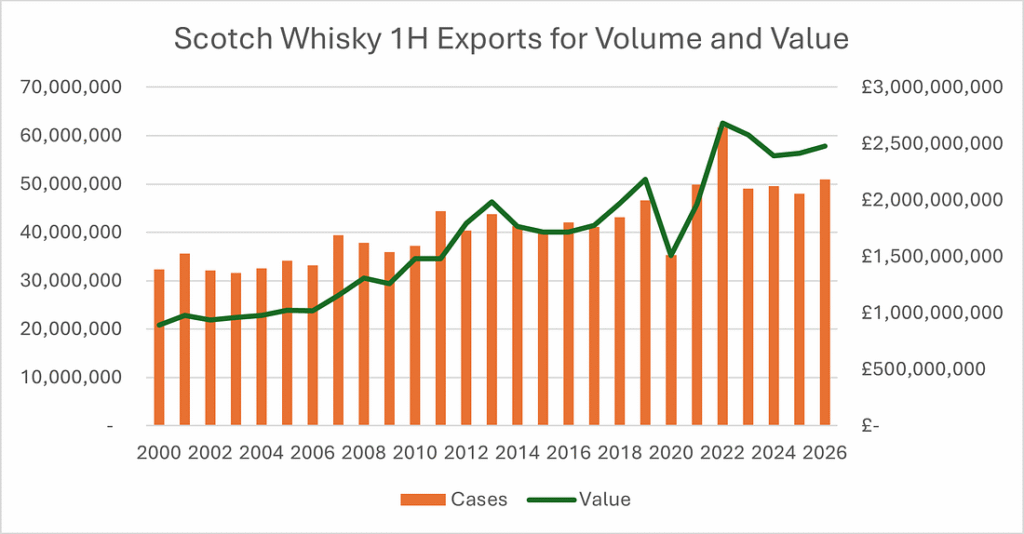
Source: Commercial Spirits Intelligence / HMRC
The figures indicate that more Scotch is once again moving into international markets – important for an industry built around global demand.
A Global Market for Scotch Whisky
Scotch whisky has long been one of the UK's most internationally recognised exports, with its fortunes closely connected to consumers well beyond Scotland.
Its geographical reach means demand is spread across established whisky markets in North America and Europe alongside large and developing markets throughout Asia, Latin America and elsewhere.
During 2026, several important developments have improved access to these international markets.
India Opens Further to Scotch Whisky
Perhaps the most significant long-term opportunity is India, one of the world's largest whisky-consuming markets.
Historically, Scotch producers have faced an import tariff of 150%, significantly increasing the cost of Scotch entering the country.
That changed on 15 July 2026, when the UK-India trade agreement came into force. India's tariff on UK whisky fell immediately from 150% to 75% and is scheduled to reduce progressively to 40% over ten years.[3]
The UK Government has estimated that the agreement could eventually increase Scotch whisky sales to India by as much as £1 billion a year.[4]
Importantly, this opportunity came after the period covered by the first-half export figures. Its impact will therefore only begin to emerge in subsequent data.
For an industry whose product can spend many years maturing before reaching consumers, improved access to a market of India's scale has clear strategic importance.
The US Tariff Picture Improves
There has also been a major development in Scotch whisky's most valuable export market.
In 2025, UK whisky exports to the United States were worth approximately £1 billion, accounting for almost one fifth of UK whisky exports.[5]
Trade conditions during the first half of 2026 were complicated by tariffs. However, on 24 July 2026, tariffs on UK whisky entering the United States were removed, returning whisky exports to a zero-tariff basis.[5]
Again, this occurred after the H1 figures were recorded. The increase in export value and volume during the first six months was therefore achieved before producers received the benefit of renewed tariff-free access to the US.
China Reduces Its Whisky Tariff
China has provided another positive development.
In January 2026, an agreement was announced to reduce China's tariff on Scotch whisky from 10% to 5%.[6]
China was Scotch whisky's tenth-largest market by value at the time, and the UK Government estimated that the tariff reduction could be worth £250 million to the UK economy over five years.[6]
Taken alongside India and the United States, the change illustrates how the international trading environment for Scotch has shifted during 2026.
A Stronger Backdrop for Global Demand
Viewed in isolation, a 3% increase in export value might appear relatively modest. The wider picture is more interesting.
Export volumes have returned to growth, export value is moving in the same direction, and barriers to Scotch entering three major international markets have been reduced.
India: whisky tariffs have fallen from 150% to 75%, with further reductions scheduled.
United States: UK whisky has returned to zero-tariff access.
China: whisky tariffs have been reduced from 10% to 5%.
Two of the most significant changes – India and the United States – occurred after 30 June, meaning their impact is not captured by the headline H1 figures.
That makes the second half of 2026 particularly interesting to watch.
What Does Export Growth Mean for Whisky Cask Owners?
For someone who owns whisky in cask, export statistics can seem removed from an asset sitting in a bonded warehouse in Scotland. In reality, both belong to the same underlying market.
A whisky cask forms part of the Scotch whisky industry's stock of maturing spirit. Depending on the cask and its eventual route to market, mature whisky may be acquired by distillers, independent bottlers, blenders or other participants in the whisky trade.
A privately owned cask does not necessarily need to become a single-cask bottling. Whisky can potentially return to the wider industry and contribute to future releases or blends, subject to the requirements of the buyer.
This is why global demand for Scotch matters. As Scotch reaches more consumers and markets become easier to access, the industry operates within a broader commercial environment for mature whisky.
Export growth should not be interpreted as a direct measure of individual cask values, which depend on factors including distillery, age, spirit quality, cask type, ABV, remaining liquid volume and market demand. Instead, export data provides an indication of the health and direction of the wider industry behind the asset.
Whisky Is a Long-Term Market
One of Scotch whisky's defining characteristics is time.
New-make spirit cannot legally become Scotch whisky until it has matured in oak casks in Scotland for at least three years, while many whiskies mature considerably longer.
The whisky being exported in 2026 may therefore have been distilled many years ago. Equally, spirit being filled into casks today may not reach its eventual market for a decade or more.
Cask ownership sits within this long lifecycle, encompassing sourcing, bonded storage, maturation, ongoing monitoring, portfolio administration and eventual exit.
Against that longer-term horizon, the first half of 2026 provides an encouraging update on demand: after a difficult period, more Scotch whisky is once again leaving Scotland for international markets.
A More Positive Backdrop for Scotch Whisky
The first six months of 2026 mark a welcome change in direction.
Volumes have increased by more than 6%. Export value has returned to growth. India has substantially reduced one of the industry's most significant trade barriers, China has lowered tariffs, and Scotch whisky has regained zero-tariff access to the United States.
Some of those developments have yet to appear in the export data at all.
For whisky cask owners, that is the bigger story behind the headline figures. A cask may spend years quietly maturing in a bonded warehouse, but its eventual commercial opportunity is connected to a global industry.
And in the first half of 2026, that industry's exports began moving in the right direction again.
Sources
- [1] HMRC - UK Trade Info: Overseas Trade in Goods Statistics View UK trade statistics
- [2] Commercial Spirits Intelligence - “A Return to Growth? 1H Scotch whisky export data for 2026” View article
- [3] UK Department for Business and Trade - UK-India Trade Deal: Conclusion Agreement Summary View agreement summary
- [4] UK Government - UK–India trade agreement comes into effect View UK–India trade agreement announcement
- [5] UK Government - US tariffs on Scotch whisky lifted View US tariff announcement
- [6] UK Government - China cuts Scotch whisky tariff View China tariff announcement
